AI BEACON #27 - The Permission Curve
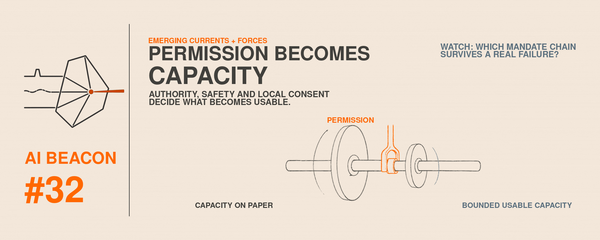
Demand can finance AI capacity. Permission determines whether that capacity can operate.
The week exposed a repeated boundary across infrastructure, regulation and agent operations: capability acquires value only after clearing distinct operating gates.
For physical AI capacity, those gates include grid reliability, financing, permits and cost allocation. For agents, they include identity, authorisation, telemetry, evidence and rollback.
Rules are also moving closer to the product surface, where access and transparency duties can reshape distribution. The cross-domain bridge is risk allocation.
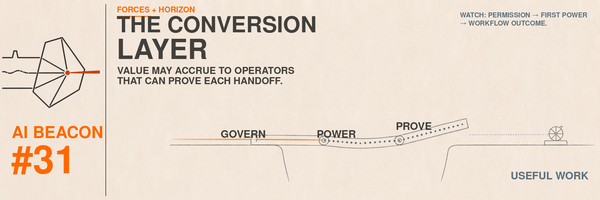
Contracts can finance a campus, and protocols can connect an agent, but neither proves permission to operate. Bargaining power could shift toward layers that assign responsibility, absorb failure and prove continuing authorisation.
Durable value capture is not yet established.
Continuity:
Previously flagged in AI Beacon #26: power was becoming a policy surface. Long-duration contracts, a capped grid auction and a moratorium now sharpen the gap between financed and operable capacity.
TL;DR
Large capacity contracts, a capped grid auction and a state moratorium exposed the gap between financed and operable AI capacity.Control surfaces are appearing in layers that allocate power, identity, policy, authorisation and evidence across the operating stack.Treat delivery milestones, enforcement artefacts and rollback evidence as gates before capacity or agent access becomes operational authority.
Subscribe for one calm, AI Beacon each week.