AI BEACON #43 - The Terms of Scale
AI is expanding what companies can attempt. The next advantage may belong to those who secure the assets, agreements and knowledge that make the work worth repeating.
Iridium entered service in November 1998 and bankruptcy the following August. Its satellites were working; its first business had failed. In December 2000, a new owner acquired the operation for $25 million, and the US Department of Defense awarded a two-year, $72 million service contract. The network survived under a different investment proposition: a new purchase price, customer commitment and operating arrangements. Preserving a useful network did not establish that the original investment had been sound.
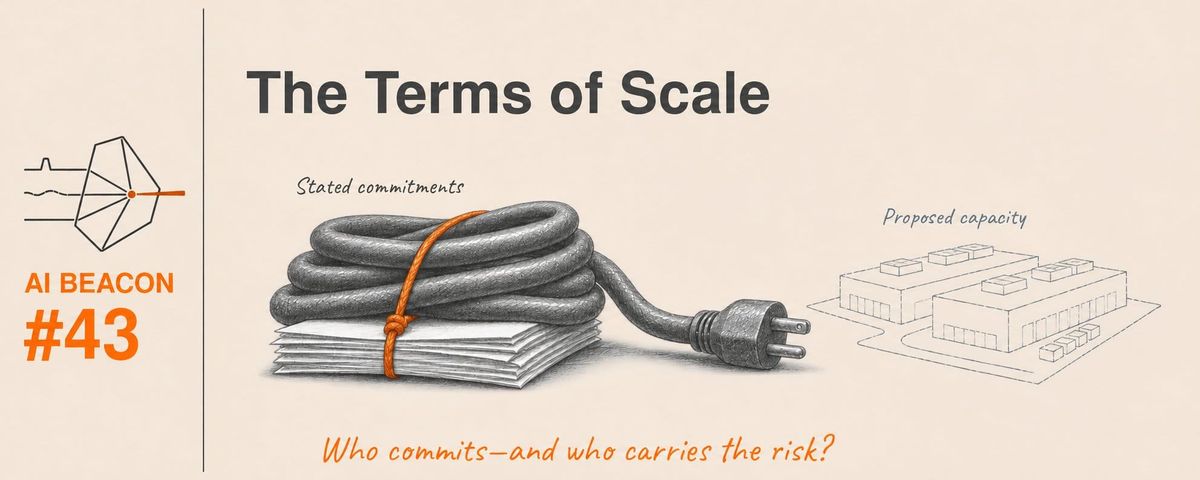
Drax has a site, power infrastructure and a new development agreement. It still needs a tenant. On 3 November, the energy company announced a partnership with Brookfield and Radiant targeting more than a gigawatt of data-centre capacity. The first phase aims for up to 100MW in early 2028, subject to approvals, commercial agreements and final investment decisions.Lambda’s proposed $33.1 billion Alabama campus makes another part of that bargain explicit.
Lambda says it will fund the required power and grid infrastructure, including upfront financial commitments that apply even if project plans change. Power remains subject to regulatory approval.
The strategic question is where the next hard commitment belongs and what must become clearer before making it. Iridium illustrates why useful infrastructure and an attractive investment are different judgements. Its rescue does not predict the outcome of today's AI projects.
Why This Should Sound Familiar
AI Beacon #26, in July, flagged that cost allocation was becoming deployment design: enforceable obligations could favour projects with clearer capacity and community terms. Seventeen issues later, Lambda says its upfront power and grid commitments will apply even if its plans change. The earlier policy question is now explicit in a developer's stated project commitments. Tracking that constraint early reveals who may carry the cost of scale - before headline gigawatts become operating capacity.
The Week in Three Moves
The assets around AI enter the bargain. Powered sites, institutional knowledge and specialist engineering can determine how much of a capability becomes useful work - and who can charge for enabling it.
The commitment can matter more than the headline. Who pays before demand arrives, which conditions remain open and what can be changed later shape the risk behind expansion.
Watch the next irreversible step. Anchor customers, investment decisions and independently validated products would change the assessment more than a larger announced project or another impressive prototype.