AI BEACON #38 - Who Keeps the Work
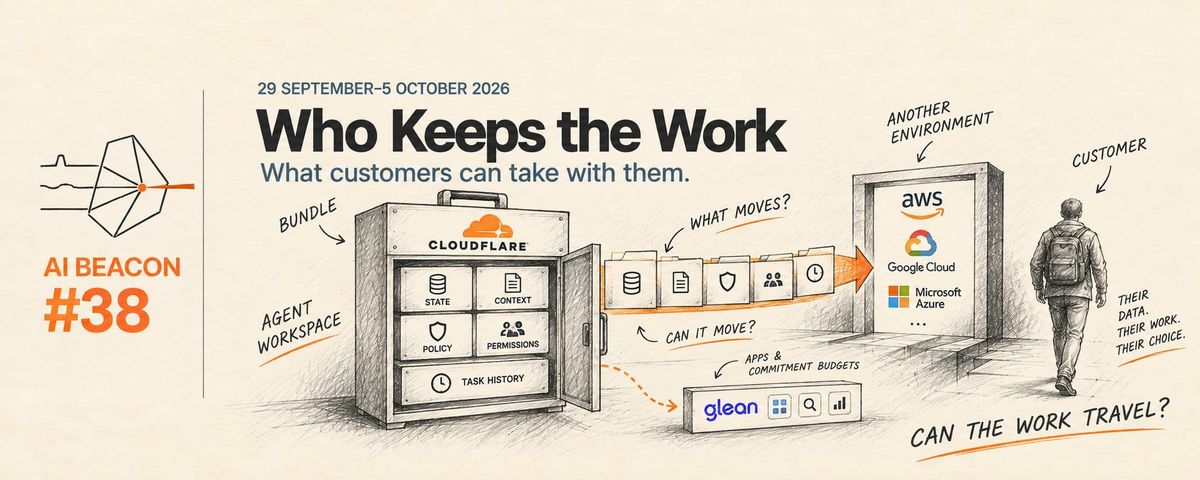
More of the agent workspace is being bundled. The strategic question is what customers can take with them.
Cloudflare put filesystem snapshots for agent sandboxes into public beta on 30 September, then opened a waitlist for fully managed Cloudflare OS the next day. That combination makes the workspace itself worth watching: Cloudflare describes identity, state and policy persisting alongside the runtime. A beta and a waitlist tell us what is being offered, not how well customers can operate it.
Glean’s existing marketplace description adds a commercial dimension. Eligible enterprises can apply part of an OpenAI commitment to qualifying partner products. An existing buying relationship could therefore influence both which software gets considered and where a deployment takes root. Eligibility does not tell us whether customers will use the products, renew them or gain negotiating power.
These are different routes toward a fuller agent bundle. Integration can remove coordination work; it can also concentrate investments in one supplier’s way of storing context, enforcing policy or selling access. Dependence would grow only if those investments became costly to reuse elsewhere. The owner of that difficult-to-replace component could capture the advantage, whether it supplies the model, the workspace or a specialist tool.
Cloudflare’s open-source OS can already be deployed in a customer’s own Cloudflare account. That offers deployment control within the supplier’s environment. It leaves the harder question open: can the useful work travel to another supplier? For an enterprise leader, that is where a convenient bundle becomes a strategic buying decision.
Why This Should Sound Familiar
July’s AI Beacon #26 asked whether a workspace could retain context, policy and task traces while models switched. Cloudflare’s current state and runtime offer, alongside AWS’s preview, gives that question a more concrete architecture. Neither demonstrates substitution or measured switching costs. The question is sharper; the commercial outcome remains unresolved.
The Week in Three Moves
The workspace accumulates value. Persistent sessions and snapshots extend the offer beyond model access. The early pattern is a growing body of operational context that customers may want to keep when they change suppliers.
Capacity does not create a customer. Epoch’s scenarios make useful demand the unresolved commercial constraint. Potential supply leaves the question of which work earns sustained spending open.
Follow the second buying decision. Qualifying budgets open a door. Watch whether partner purchases become recurring use and renewal; that transition would say more about durable distribution advantage than eligibility alone.