AI BEACON #39 - Permission to Act
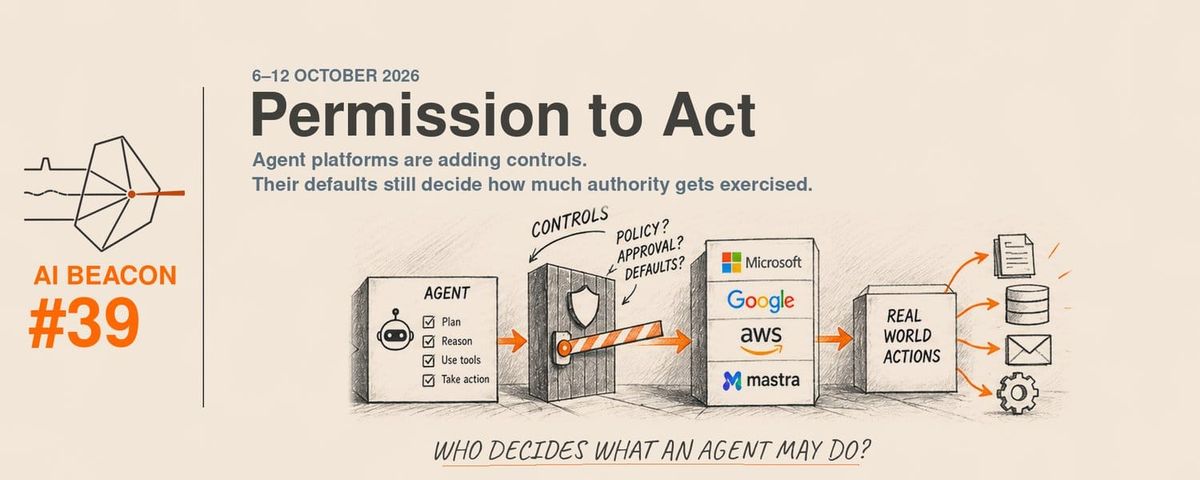
Agent platforms are adding controls. Their defaults still decide how much authority gets exercised.
Microsoft’s Execution Containers place policy outside the agent workload. In a separate release, Mastra made approval optional by default for MCP-discovered tools in mastra/connect 1.0. They put two deployment choices in view: where a boundary is enforced, and whether an approval step is active.
Both choices can coexist in a capable system. They also expose a gap in the phrase ‘an agent with controls’: which controls, switched on by whom, covering which actions? A buyer needs those answers before deciding how much authority to delegate.
Google’s announced persistent work agent brings the question into longer-running work. The ability to continue a task creates a practical need to identify who can change its mandate while it runs. These announcements describe architectures and defaults; they do not independently establish that containment works. The useful shift this week is a clearer division between choosing an action and authorising its effects. That distinction helps operators compare products without confusing a more capable model, a configurable safeguard and an enforced limit. The rest of the map keeps the other constraints visible: task acceptance, operating cost and physical infrastructure.
Why This Should Sound Familiar
AI Beacon #01 urged readers to “put a policy layer in front of your tools”. This week adds inspectable details: Microsoft places policy outside the workload; Mastra leaves a tool-approval choice to developers. Whether those configured boundaries hold during real work remains an open test.
The Week in Three MovesA separate say over action. Early agent architectures distinguish generating work from granting permission to execute it. That gives enterprises a more precise place to examine who owns the decision.
Configuration sets the real boundary. An available safeguard may remain inactive or cover only some paths. Check the operating configuration before treating a product’s control catalogue as a deployment guarantee.
Watch the stop function arrive. The approaching physical-action policy date creates a concrete watchpoint: observable operator intervention and safe disconnection in covered systems, beyond publication of the requirement.